
Why 75% of Enterprise AI Agent Projects Fail Without a Centralized ERP Foundation
Every enterprise AI agent project starts with the same promise: automate the complex, reduce the manual, unlock productivity at scale. Six months later, the same teams are quietly shelving pilots that never made it to production. The agents hallucinate on stale data, create conflicting records across systems, or produce outputs that the finance team won't sign off on because no one can trace where the numbers came from.
The failure is rarely about the AI model. GPT-4o, Claude 3.5 Sonnet, and Gemini 1.5 Pro are all capable of sophisticated reasoning. The failure is almost always about data architecture — specifically, the absence of a single source of truth that the agent can trust.
After 180+ enterprise engagements and $2.1B in client value created, Techseria has identified one consistent pattern: the organizations that succeed with AI agents have a unified, real-time operational data layer. The ones that fail are trying to make agents reason across siloed systems that disagree with each other.
The "Just Connect to Existing Systems" Trap
The most dangerous objection we hear from enterprise IT teams is: "We'll just connect the agents to our existing systems via API."
This sounds reasonable. You have a CRM. You have a procurement system. You have a legacy ERP from 2014 and a few departmental databases running in spreadsheets that someone promised to migrate three years ago. Connect them all with API tool nodes, give the agent access, done.
Here is what actually happens.
An AI agent reasoning across five systems will encounter data that contradicts itself within the first 48 hours of production use. Your CRM says a customer's credit limit is $250,000. Your ERP says it's $200,000 because a finance team member updated it yesterday but the CRM sync runs overnight. Your procurement system doesn't know about credit limits at all — it just fires purchase orders. The agent, trying to approve a $220,000 purchase order, has three different answers to a binary question.
This is not an edge case. In a mid-market enterprise with 200–1,000 employees, this kind of data inconsistency happens dozens of times per day across different entities, workflows, and departments. A human operator navigating these systems has institutional knowledge — they know to check the ERP first for financial data, they know the CRM sync lags. An AI agent has no such institutional knowledge unless you encode it explicitly.
And here is the deeper problem: even if you encode business rules to resolve conflicts, you are now maintaining a layer of conflict-resolution logic that duplicates your operational data layer. Every time your underlying systems change — a new integration, a schema migration, a department that switches tools — your agent's conflict resolution layer breaks in ways that are silent and expensive.
What Stateful Agents Actually Need
LangGraph.js is a state machine framework for building AI agents. Every node in a LangGraph graph reads from and writes to a typed state object. That state object is the agent's working memory for a given task execution.
Here is the architectural truth that most teams miss: the quality of the agent's reasoning is bounded by the quality of the data in its state. If you populate that state from five inconsistent sources, your agent reasons on inconsistent state. Garbage in, garbage out — but now it's happening autonomously, at scale, with your procurement budget.
A stateful LangGraph.js agent needs:
1. A canonical data model. Every entity the agent reasons about — customers, suppliers, inventory, purchase orders, invoices — must have one authoritative record. Not five records across five systems that are supposed to be in sync.
2. Real-time read access. If an agent is approving a purchase order, it needs the current credit limit, not last night's sync. Stale reads create confident wrong decisions.
3. Write-back coherence. When an agent creates or updates a record, that change must propagate immediately to all downstream consumers. If the agent approves a purchase order and that approval sits in a queue for 30 minutes before hitting the ERP, the next agent action might be operating on the pre-approval state.
4. Transactional integrity. Multi-step agent workflows frequently involve compound operations — update inventory, create an invoice, send a notification, update a customer record. These need to either all succeed or all fail. Partial completion is often worse than complete failure.
Why ERPNext Solves This Specifically
ERPNext is an open-source, full-stack ERP that covers accounting, inventory, procurement, CRM, manufacturing, HR, and project management in a single unified data model. Every module shares the same database, the same authentication layer, and the same REST API surface.
When Techseria architects LangGraph.js agents for enterprise clients, we use ERPNext as the operational data backbone for a specific set of reasons:
Single database, no sync lag. When finance updates a customer's credit limit, the procurement module sees it immediately. There is no sync job. There is no eventual consistency window. An agent calling the ERPNext REST API for a customer's credit limit gets the same answer regardless of which departmental lens it's looking through.
Structured document model. ERPNext models business operations as typed documents — Sales Order, Purchase Order, Payment Entry, Stock Entry. These documents have defined statuses, defined field schemas, and defined workflow transitions. This is exactly the kind of structured, typed data that LangGraph.js agent tool nodes consume cleanly.
Audit trail native. Every change to every document in ERPNext is logged with timestamp, user, and old/new values. When an AI agent modifies a record, that modification appears in the audit trail exactly like a human action would. This is non-negotiable for finance and compliance teams.
Scriptable workflow engine. ERPNext's server scripts and workflow engine let you define approval chains, validation rules, and notification triggers. LangGraph.js agents can both trigger and respond to ERPNext workflow events, creating a bidirectional integration where the agent and the ERP collaborate rather than the agent operating outside the ERP's governance model.
The Architecture: LangGraph.js + ERPNext in Practice
Here is how Techseria structures the integration in a typical accounts payable automation deployment:
The LangGraph.js state schema includes typed fields for the invoice document, vendor record, purchase order reference, and approval status — all pulled directly from ERPNext document types.
The agent graph has the following node sequence:
- fetch_invoice_node: Calls ERPNext REST API, fetches the submitted invoice document with all linked references resolved
- validate_po_match_node: Pulls the linked purchase order, performs three-way match (PO quantity, receipt quantity, invoice quantity)
- check_vendor_compliance_node: Queries vendor master for active status, compliance certifications, payment terms
- approval_routing_node: Conditional routing based on invoice amount — under $10K goes direct, $10K–$100K routes to department head, over $100K goes to CFO
- human_review_node: LangGraph.js interrupt, pushes review request to Slack with full context, waits for approval signal
- post_approval_node: On approval, calls ERPNext API to submit payment entry, updates invoice status
Every piece of data in this workflow comes from one source: ERPNext. There is no cross-system reconciliation. The agent's state is always coherent because the underlying data model is coherent.
The result for one of our manufacturing clients: invoice processing time dropped from 6.2 days average to 14 hours. Error rate on three-way matching dropped from 8.3% to 0.4%. The finance team's exception queue went from 120 items per week to 11.
The Migration Objection
"But we're not on ERPNext. We use SAP / Oracle / NetSuite / a combination of Salesforce, QuickBooks, and spreadsheets."
This is real, and we hear it constantly. The answer is not "rip and replace your current systems before starting AI." That would take 18 months and kill the business case.
The answer is a phased approach. In phase one, ERPNext is deployed alongside existing systems as the AI operational layer — it ingests data from current systems via integration, maintains a clean canonical model, and serves as the single source of truth for the AI agent. Existing systems continue operating as they do. The integration layer handles sync, with ERPNext as the master for agent-facing data.
In phase two, as teams gain confidence in the ERPNext data model, operational workflows gradually migrate to ERPNext natively. By phase three, ERPNext is the primary operational system and the integration layer is simplified or removed.
This phased approach means you can begin getting value from AI agents within 6–8 weeks while building toward the long-term architectural foundation.
What Good Looks Like
The enterprises getting real production value from AI agents share a common characteristic: they treat data architecture as a first-class concern, not an afterthought. They have answered the question "what is the authoritative source for this entity?" before they write a single line of agent code.
The ones that fail treat data architecture as someone else's problem. They assume the agent will figure it out. It doesn't. It can't.
If you are evaluating an AI agent implementation partner and they are not asking hard questions about your data architecture in the first conversation, they are selling you a proof of concept that will not survive contact with your production environment.
Techseria's engagement methodology starts with a data architecture assessment. We map your operational data model, identify the conflicts and gaps, and design the ERPNext integration layer before a single LangGraph.js node is written. This is why our deployments succeed where others stall.
Ready to deploy AI agents that actually work in production? Book a Strategy Session with Techseria — we'll map your data architecture and show you exactly what it takes to move from pilot to production.
[Book a Strategy Session](https://techseria.com/contact)
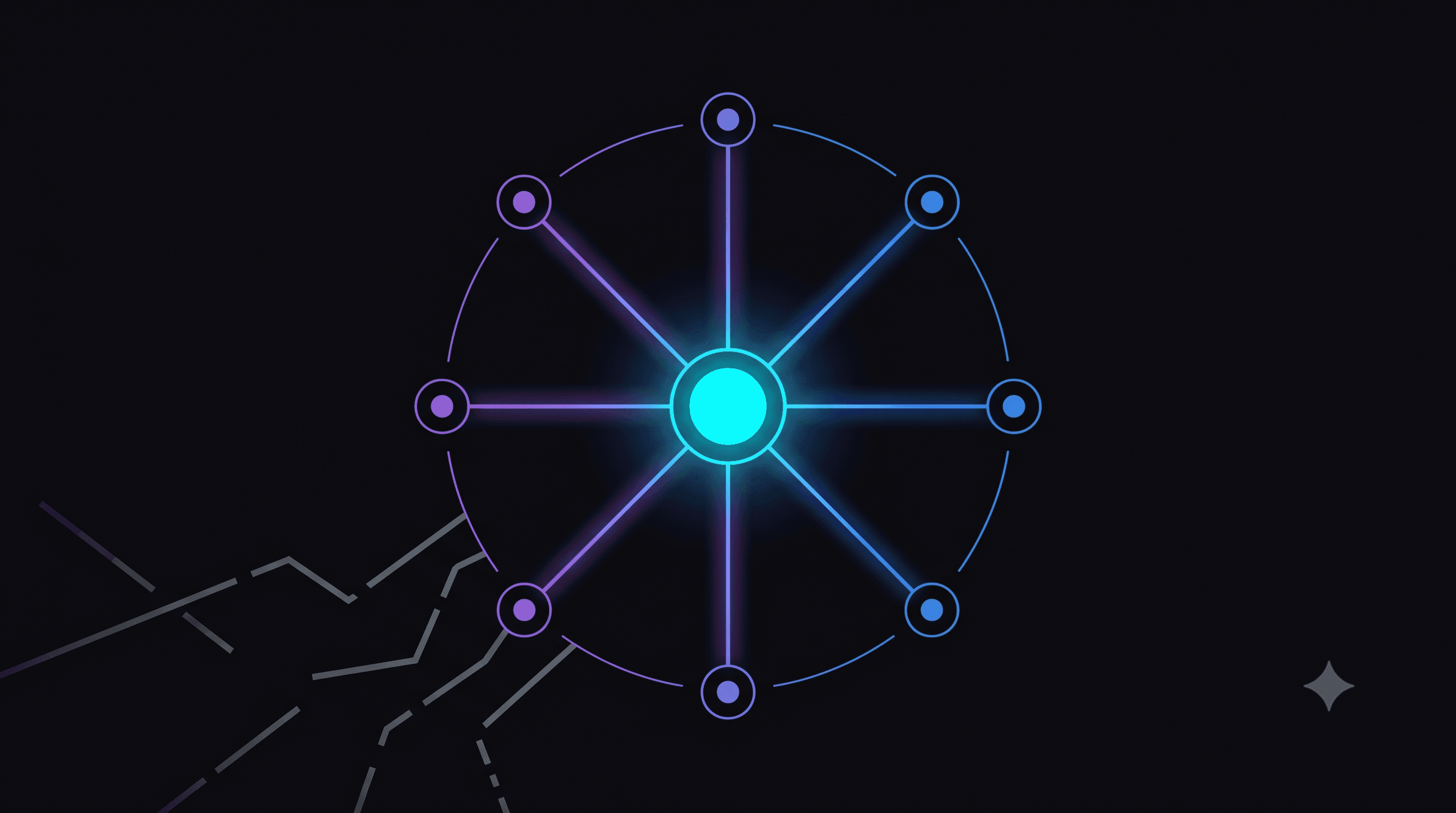
IMAGE PROMPT: A dark, abstract enterprise data architecture visualization. Background is deep black (#0a0a0f). A central glowing node in vibrant cyan represents a unified ERP core. From it, radiate clean geometric lines in purple and electric blue connecting to smaller satellite nodes arranged in a circle — representing CRM, procurement, finance, inventory, and HR modules. The connecting lines pulse with a soft gradient glow suggesting data flow. Fragmented, broken lines in muted grey extend off-canvas in the lower left, representing siloed legacy systems. The overall composition is minimal, symmetrical, and premium. No text, no logos, no people. Abstract semi-technical aesthetic. Aspect ratio 16:9 at 1920x1080px. The mood is authoritative, modern, enterprise-grade.
Ready to accelerate your operations?
See how custom AI solutions, ERPNext integration, and workflow automations can lower your operating costs. Book your free 30-minute Workflow Audit with a senior engineer.