
ERPNext for Manufacturing in India: 2026 Guide
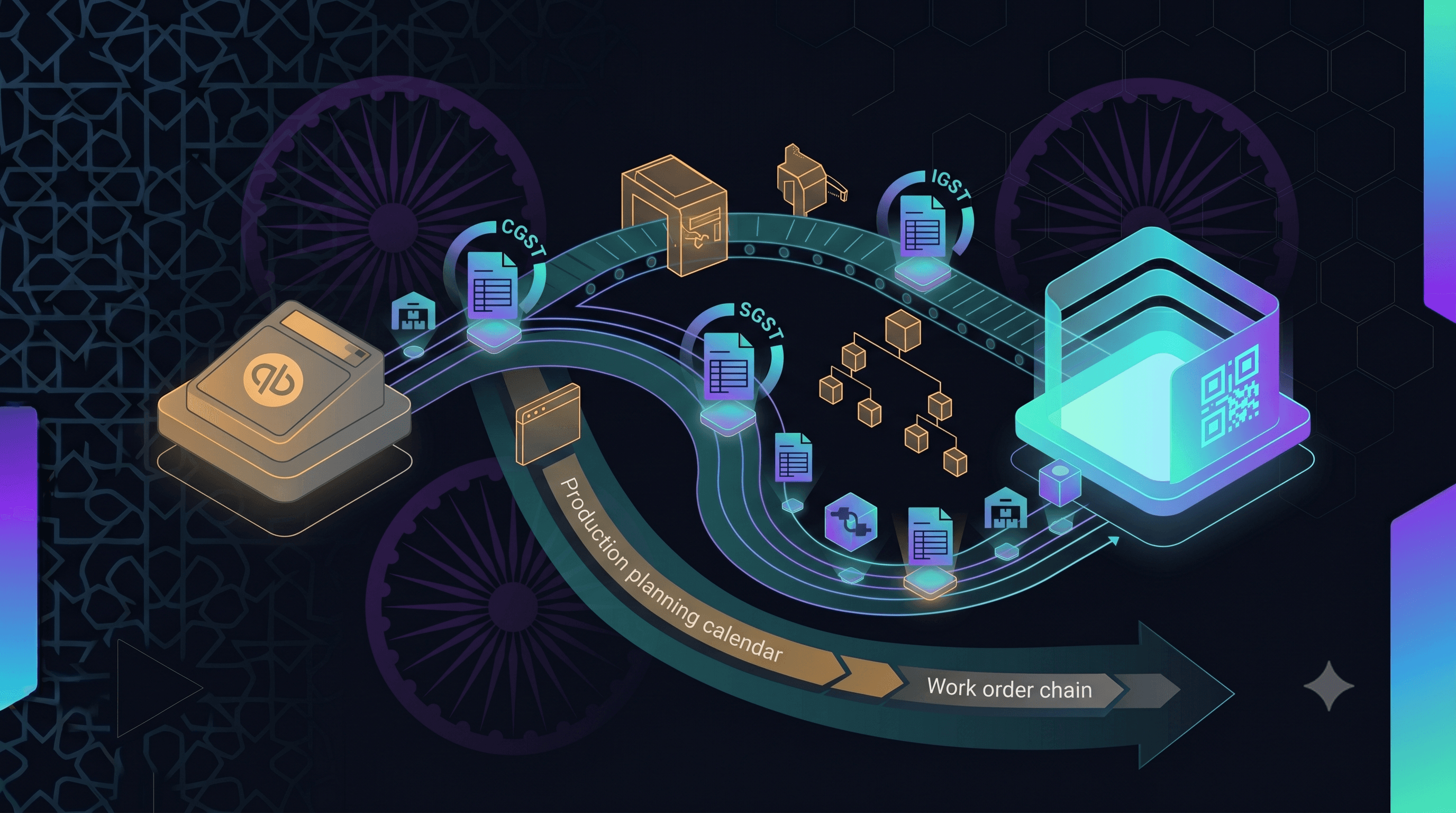
Indian manufacturing companies have a unique compliance burden: GST with multiple rates and HSN codes, mandatory e-invoicing above the threshold turnover, e-way bills for goods movement, TDS deduction at source, TCS collection at source, and often multiple plant locations with separate GST registrations. ERPNext handles all of this natively, but the configuration requires care.
Manufacturing Module: Core Capabilities
Bill of Materials (BOM): ERPNext supports multi-level BOMs with raw materials, sub-assemblies, and finished goods. Each BOM line specifies the item, quantity, UOM, and optionally the source warehouse. Operations can be added to BOMs with standard times and workstation costs. BOM versioning allows tracking changes over time.
Work Orders: Work Orders are created from Sales Orders or production plans. Each Work Order specifies the item, quantity, BOM version, planned start/end date, and target warehouse. Work Orders can be split by operation across multiple workstations. Material transfer from stores to WIP happens via Stock Entry (Material Transfer for Manufacture).
Job Cards: Job Cards track time against each operation in a Work Order. Operators record start time, end time, and quantity completed. Job Cards feed into actual cost calculation (actual vs standard cost variance). Quality Inspection can be linked to Job Cards for in-process quality control.
Production Planning: The Production Plan in ERPNext analyses Sales Orders and Stock Requests, explodes the BOM to raw material level, checks stock availability, and generates material requests for shortfalls. It can generate multiple Work Orders from a single production plan.
GST Configuration for Manufacturing
HSN Code Setup: Every item in ERPNext must have the correct HSN/SAC code assigned. HSN codes determine the applicable GST rate. ERPNext's India Compliance app (maintained by Frappe) includes an HSN code master and automatically validates HSN codes against the GST rate structure.
Tax Templates: For manufacturing companies, you typically need tax templates for: CGST + SGST (intrastate supply), IGST (interstate supply), GST Exempt (for exempt goods), GST Zero-rated (for exports), Reverse Charge (for specific services). Each template specifies the account heads and rates.
Multi-GSTIN Setup: Manufacturing companies with plants in multiple states need separate GSTINs per state. ERPNext supports this through the company address configuration — each address (plant location) can have its own GSTIN, and the system selects the correct GSTIN based on the shipping/billing address combination.
E-Invoicing Configuration
E-invoicing is mandatory for businesses with annual aggregate turnover above INR 5 crore (as of April 2023). ERPNext's India Compliance app integrates directly with the IRP (Invoice Registration Portal) via API. Configuration steps: 1. Enable e-invoicing in India GST Settings. 2. Enter your IRP credentials. 3. Set up the e-invoice API endpoint. 4. Configure the auto-generate trigger (on Sales Invoice submission). On submission of a qualifying Sales Invoice, ERPNext automatically generates the e-invoice JSON, submits it to IRP, receives the IRN and QR code, and embeds them in the invoice PDF.
E-Way Bill Configuration
E-way bills are required for movement of goods above INR 50,000 in value (inter-state) or as required by state rules (intra-state). ERPNext generates e-way bill JSON directly from the Delivery Note or Sales Invoice. The India Compliance app supports direct API integration with the NIC e-way bill portal. Key fields required: transporter ID, vehicle number, distance, supply type, and document date.
TDS and TCS Configuration
TDS (Tax Deducted at Source): ERPNext supports TDS configuration per supplier and transaction type. TDS categories (194C for contractors, 194J for professionals, etc.) are configured in the Tax Withholding Category master. Once configured, ERPNext automatically calculates TDS on qualifying Purchase Invoices and creates the TDS payable entries.
TCS (Tax Collected at Source): TCS applies to sales of specific goods above the threshold (Section 206C). ERPNext calculates TCS on qualifying Sales Invoices when configured in the item master and customer settings.
Common Configuration Mistakes
1. Incorrect HSN codes on items. Affects e-invoicing validation and GSTR-1 filing. Audit all items before go-live.
2. Wrong tax template applied automatically. Set default tax templates at the item group level, not just the company level.
3. Place of Supply misconfiguration. The Place of Supply determines CGST+SGST vs IGST. Verify that the Place of Supply is being set correctly on every transaction type.
4. BOM cost not updated after raw material price changes. Run the BOM Update Tool monthly to keep standard costs current.
Techseria has implemented ERPNext for manufacturing companies across India, UAE, and the UK. Book a Strategy Session to discuss your specific manufacturing and compliance requirements.
Ready to accelerate your operations?
See how custom AI solutions, ERPNext integration, and workflow automations can lower your operating costs. Book your free 30-minute Workflow Audit with a senior engineer.