One Unified Intelligence
Not 36 separate bots. MIRA routes every question to the right specialist, and all of them share one set of plant records, one permission model and one Decision Trail.
Ask in plain language: "Why did line 2 use more kWh per kg this week?" or "What will stop us breaching contract demand today?" MIRA's supervisor sends the question to the right specialist. The specialist calculates the answer from your own plant records with 306 purpose-built tools, shows exactly what it read, and links to the agent run behind it. A question never triggers an action.
No commitment Fixed-fee Discovery Response within 4 hours
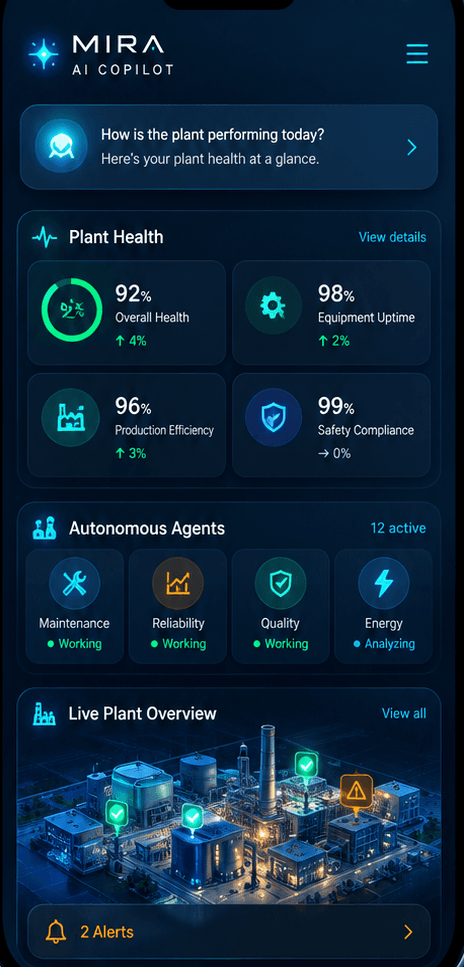
MIRA isn’t a chatbot or a set of disconnected tools. She is one plant intelligence that runs on her own or alongside the systems you already have. She reads your machines, meters and records, and 36 specialist agents each own a domain, from maintenance and energy to quality, safety and finance.
Not 36 separate bots. MIRA routes every question to the right specialist, and all of them share one set of plant records, one permission model and one Decision Trail.
PLCs, historians, meters, spreadsheets, ERP and CMMS. Start on day one with CSV or Excel alone. Each source you connect switches on more capability, with no data migration.
Each action type has a confidence threshold you set. Below it, a named person approves. Asking a question never raises a work order or writes to another system, and every action is logged and auditable.
MIRA's intelligence runs a continuous loop: observe, analyse, then act or ask, with the evidence attached at every step.
Reads machines, meters, historians, work orders and business records across every site. A device that cannot be reached is reported as absent, never as zero.
Purpose-built tools run deterministic calculations such as OEE, energy per piece, MTBF, fault rules and Weibull. The agent interprets the result and says plainly when data is missing.
Recommends, or acts within your thresholds. Every answer links to its agent run, with a plain-words summary of what was read, concluded, recommended and approved.
Each agent below is a specialist inside MIRA's intelligence, with its own tools and calculations. All of them share your plant records, respect each user's permissions and report through one orchestration layer. Select an agent to see its capabilities and an example question.
Health, Risk & Condition
Scores equipment health daily, detects condition changes against each asset's own baseline, tunes PM intervals and checks spare-part availability before recommending a job. Prescriptions are refreshed every hour on their own.
Workforce Optimization
Matches technicians to jobs by availability, skill and workload, resolves scheduling conflicts and smart-assigns PM work.
Work-Order Lifecycle
Creates, assigns, prioritises and closes out work orders, turns approved prescriptions into jobs, and learns from how each job was resolved.
TCO & Replacement
Tracks lifecycle status, warranty and total cost of ownership for every asset, with repair-versus-replace and replacement recommendations.
Safety & Compliance
Monitors permits, LOTO, certifications and audits, and validates work orders against them. An unknown expiry is shown as unknown, never as safe.
Crisis & Incident Response
Emergency plans, active incidents, escalation, investigation support and learning from past incidents.
Failure Root-Cause Engine
Finds recurring failures and turns them into corrective actions, using stop-reason Pareto, machine-state timelines, energy drift and OEE loss patterns.
PM Scheduling Optimizer
Optimises PM intervals, packs the calendar, balances workload and flags planning conflicts.
Financial Optimization
Analyses spend, TCO and the maintenance-cost ratio, tracks budget variance and recommends where to save.
Budget Forecasting Engine
Summarises maintenance costs, forecasts spend and recommends budgets.
Contract & Vendor Intelligence
Guides AMC renewal or replacement, scores vendor performance, summarises SLA penalties and compares contracts.
Inventory & Reorder Intel
Monitors stock, consumption, reorder points and stock-out risk. Material requests and POs are recommend-only until you confirm them.
Energy & Demand Intelligence
Covers maximum demand vs. contract, power factor, energy roll-up, time-of-day cost, energy per piece, compressed-air specific power, idle energy, best operating point and approved savings. It has 23 tools.
FMEA & Risk Ranking
Answers FMEA/FMECA questions, reliability metrics, risk ranking, evidence and sign-off status. Read-only.
Technician Metrics
Technician metrics and comparisons, training needs, workload and performance trends.
Work Order Ranking Engine
Ranks work orders by SLA, asset health and reliability, and technician capacity, so the right job is done first.
Governed Autonomous Execution
Carries out governed writes such as quarantine, LOTO, handovers, procurement, energy actions and escalations, always behind your permissions and approval thresholds. It has 29 tools.
Pattern & Cascade Detection
Detects anomalies against each asset's own baseline, finds similar past events and flags cascade risk across related equipment.
Continuous Self-Improvement
Runs MIRA's internal improvement cycle, learning from prediction outcomes and technician feedback. It works behind the other agents and is not a chat destination.
Automated Stakeholder Messaging
Sends SLA-breach messages, escalations, reports and scheduled communication over the channels you permit.
The Director's Daily Briefing
Plant KPIs, trends, safety summaries, facility comparisons, what-if analysis and RCA, in the language leadership uses.
ESG Reporter
Covers scope 1 and 2 emissions, carbon trends, reduction opportunities, ESG data and carbon benchmarking. India's CEA grid factor and IPCC 2006 fuel factors are pre-loaded, and every figure shows its factor, source and year. Scope 3 is not computed.
Facility & Industry Benchmarking
Compares facilities and lines on energy per piece, shift attainment and OEE losses, and surfaces best practices.
Digital Facility Manager
Finds cross-training gaps and warranty/PM overlap, reassigns work after equipment moves, and advises on lead-time reorders.
Line Starvation Tracker
Pareto of starved minutes by station, material and shift, converted to units lost, with replenishment fixes.
Setup-Time Intelligence
Detects setup-time creep per product pair, suggests a better sequence, and tracks shift attainment, OEE losses, stop reasons and money lost on the live line.
Utility Loss Detection
Finds compressed-air leaks, water-balance gaps, DG-fuel variance and idle energy, shown as variances rather than accusations.
Quality Loss Tracker
Covers SPC with the Western Electric rules and the six-point trend, FPY drift, defect clusters by shift, crew, lot or model, and scrap and rework cost.
Supplier Quality Intel
Tracks supplier rejection PPM, sampling risk with MIL-STD-105E sampling plans, debit notes not yet raised and CAPA ageing.
Service Waste Tracker
Covers meal waste and no-shows, transport seat and boarding utilisation, and over-ordering of soft services.
These agents cover handover, knowledge, workforce leakage, demand forecasting, decision valuation and general help, so every part of the plant has a specialist.
Workforce Leakage
Checks shift readiness, turnout, contract-labour billing and man-days confirmed by attendance, so you pay only for labour that was actually delivered.
Cited Procedure Answers
Gives cited answers from your own SOPs, checklists, PM schedules and indexed OEM manuals, right when the technician needs them.
Handover Notes
Writes the handover narrative from open work, risks, priorities, escalations, permits and LOTO, and flags stale handovers.
Remedy Valuation
Values each remedy by net value, payback and cost of waiting, then builds the best basket of actions within your budget and crew capacity.
Resource & Parts Demand
Forecasts maintenance and resource demand, seasonality, capacity plans and parts demand from your own history.
General Assistant
Handles general help, navigation and requests outside the specialist domains, and passes anything specialist to the right agent.
Autonomous doesn't mean unaccountable. You set a confidence threshold for each action type. Below it, MIRA presents its recommendation, confidence and evidence, and waits for a named person to approve before acting.
Every pending action sits in a queue with delegation and escalation. Approvals left unanswered expire under a rule you set, and the full decision log, including rejections and expiries, exports as CSV or JSON.
Procurement tools return the exact material request or purchase order they would create and wait for your confirmation. Writes to SAP or FacilityFlow stay off until you enable them, and MIRA never deletes anything externally.
MIRA's agents read your machines directly, prescribe the fix, and prove the saving, with every figure traceable to its source.
Native readers for OPC-UA (with HistoryRead backfill), MQTT 3.1.1 or 5 with Sparkplug B, Modbus TCP and RTU, Siemens S7, EtherNet/IP and historians, polled on the interval you declare. Tags are bound to equipment from a screen. No new hardware, and MIRA never writes to your control systems.
Learn morePrescriptions are produced every hour on their own. Each names the asset, component, action, act-by date and expected impact against a named baseline, and says whether the spare is in stock. It becomes a work order only through your approval gate, and the technician's close-out feeds back.
Learn moreA baseline is captured at go-live, and energy is measured against a production-normalised baseline. Each saving waits for your own engineer's approval, which is recorded once and cannot be altered, before it counts toward the headline total.
Learn more