SOPs no one enforces
Tasks lack estimates, dates, and time logs. Nobody chases them consistently. Process documents that nobody follows create invisible delivery risk that compounds over time.
Sutra deploys 17 named AI specialists on top of your ERPNext — watching every project, task, and person around the clock, enforcing your SOPs on a graduated ladder, and drafting every correction for a human to approve.
.png&w=3840&q=75)
Estimates go missing. Timesheets get skipped. Deadlines slip. Budgets overrun. HR queries pile up. By the time anyone notices, it's already expensive to fix.
Tasks lack estimates, dates, and time logs. Nobody chases them consistently. Process documents that nobody follows create invisible delivery risk that compounds over time.
Named agents watch every task, log, and project 24/7. A configurable Detect → Notify → Escalate → Act ladder enforces your standards automatically and graduated — without adding management headcount.
Burn-rate and schedule risk surfaces at month-end, when corrective action costs far more than early intervention would have. By then, the deadline is already missed.
Tempo's burn-rate analysis and overrun forecasts surface budget and schedule risk while you can still act — not at month-end when the damage is done and the deadline is gone.
Your HR team answers the same leave, payroll, and policy questions every single day — preventing them from doing higher-value work that actually needs human judgment.
Echo answers leave, attendance, payroll, and policy questions directly from live ERP data — freeing your HR team for work that actually needs human judgment and expertise.
Cases are triaged manually, routed incorrectly, and handled with inconsistency. Compliance exposure accumulates silently until it becomes a serious problem.
Haven classifies every grievance across 9 categories, assigns SLAs, and routes it safely — never to the person the case is against, with confidential handling for sensitive matters.
Project managers spend hours drafting, chasing, and formatting updates that should be automated — taking them away from the delivery work that actually matters.
Tasks lack estimates, dates, and time logs. Nobody chases them consistently. Process documents that nobody follows create invisible delivery risk that compounds over time.
Burn-rate and schedule risk surfaces at month-end, when corrective action costs far more than early intervention would have. By then, the deadline is already missed.
Your HR team answers the same leave, payroll, and policy questions every single day — preventing them from doing higher-value work that actually needs human judgment.
Cases are triaged manually, routed incorrectly, and handled with inconsistency. Compliance exposure accumulates silently until it becomes a serious problem.
Project managers spend hours drafting, chasing, and formatting updates that should be automated — taking them away from the delivery work that actually matters.
Named agents watch every task, log, and project 24/7. A configurable Detect → Notify → Escalate → Act ladder enforces your standards automatically and graduated — without adding management headcount.
Tempo's burn-rate analysis and overrun forecasts surface budget and schedule risk while you can still act — not at month-end when the damage is done and the deadline is gone.
Echo answers leave, attendance, payroll, and policy questions directly from live ERP data — freeing your HR team for work that actually needs human judgment and expertise.
Haven classifies every grievance across 9 categories, assigns SLAs, and routes it safely — never to the person the case is against, with confidential handling for sensitive matters.
Sutra organizes its intelligence the way a business organizes its people — specialists that own their domain, coordinated centrally by Axis, working continuously around the clock.
Echo (self-service), Halo (HR documents), Cadence (attendance patterns), Atlas (manager dashboards), Ledger (payroll review), Scout (recruitment pipeline), Compass (onboarding), Codex (policy compliance), Haven (grievance triage), Prism (training evaluation), Pulse (activity tracking).
Vector (portfolio and project health), Tempo (burn rate and overrun forecasts), Tally (task hygiene and git linkage), Sentry (delivery risk per project), Brief (status report drafting for human approval).
Classifies every request and routes to the right department lead, which routes to the right specialist. The safety routing cannot be bypassed — every intent reaches the correct expert.
The only agent that performs approved writes to your ERP. Distributed locking, freshness validation, conflict checks, and post-execution audit — on every single write, without exception.
Each agent only sees and touches what its role requires. Bounded data access, explicit write permissions, and hard-coded prohibited actions that no configuration can override — terminations, salary changes, deletions, backdating.
Talk to any agent directly in the console — 'Vector, how is the portfolio?' or 'Echo, what is my leave balance?' Named personas make the system feel like colleagues, not black-box software.
Enterprise buyers hesitate to let AI touch their systems. Sutra is engineered so that hesitation disappears — governance is the architecture, not a layer bolted on top.
Agents draft proposals with full before/after context. Humans approve, modify, or reject from a priority-sorted queue. Only then does the system execute. No agent writes to your ERP autonomously — ever.
Terminations, salary changes, record deletions, and backdating are permanently prohibited. No configuration, no override, no exceptions. They are hard-blocked in the architecture itself.
Every agent action, decision, approval, rejection, and write is logged permanently. Full traceability for compliance audits, internal review, and trust-building with stakeholders.
One switch halts all autonomous activity and write-backs instantly. Read-only monitoring keeps running so dashboards stay current. Individual rules can also be waived or snoozed independently.
Policy and compliance answers are verified against your knowledge base. Weak grounding adds a caveat automatically. An independent verifier re-checks higher-risk proposals. Numbers are never made up.
One dedicated install wired to your own ERPNext — in your environment. Your data never enters a shared pool. No model training on your data. AES-256-GCM encrypted secrets. HMAC-signed webhooks with replay protection.
%2520or%2520hero%2520area.png&w=3840&q=75)
Sutra connects to ERPNext and Frappe as the system of record via standard REST APIs — no custom modules, no schema changes, no new system to learn.
Project timelines slip when tasks lack estimates and timesheets are not logged. PMs spend hours chasing updates and drafting status reports instead of managing delivery. Clients get updates late, or not at all.
Tally detects missing estimates, dates, and time logs and escalates on a configurable ladder. Brief drafts customer and internal status updates ready for one-click approval. Tempo forecasts overruns before they become missed deadlines.
Measurable improvements in on-time delivery, significant reduction in PM admin hours, and faster client reporting with less manual effort from the team.
Git commits and task statuses are out of sync — tasks marked done with no merged code, or code ships without a matching task. Sprint velocity is guesswork. HR policies are applied inconsistently as headcount scales rapidly.
Tally links every commit and merge request to its task and flags mismatches in real time. Tempo forecasts sprint overruns while there is still time to act. Codex enforces HR policy consistently as the team grows.
Engineering delivery becomes visible and truthful — status reflects what actually happened. HR compliance scales with headcount without adding HR headcount.
HR handles the same leave, payroll, and policy questions every day. Grievances are managed manually with inconsistency, creating compliance exposure. Management visibility relies on spreadsheets and weekly status meetings that everyone hates.
Echo deflects repetitive HR self-service queries from live ERP data. Haven triages every grievance with SLA assignment, severity classification, and confidential routing that never reaches the subject. Atlas gives managers real-time team dashboards.
Significant reduction in HR query volume, consistent and defensible grievance handling, and management visibility without scheduling overhead.
Dashboards show you problems after they happen. Sutra detects violations, notifies owners, escalates if ignored, and acts — continuously, across every project, without adding management overhead.
A configurable four-stage ladder per rule — with grace periods, reminder frequencies, and per-rule autonomy settings. The right response at the right time, not a flood of alerts from day one.
Missing estimates, missing start and end dates, thin task descriptions, stale tasks, no time logged, overdue projects — and more. Tune thresholds, grace periods, and actions per rule to your team's reality.
Per-project violation digests delivered in real time and by email. One consolidated summary per project — not a per-violation notification flood that trains people to ignore the inbox.
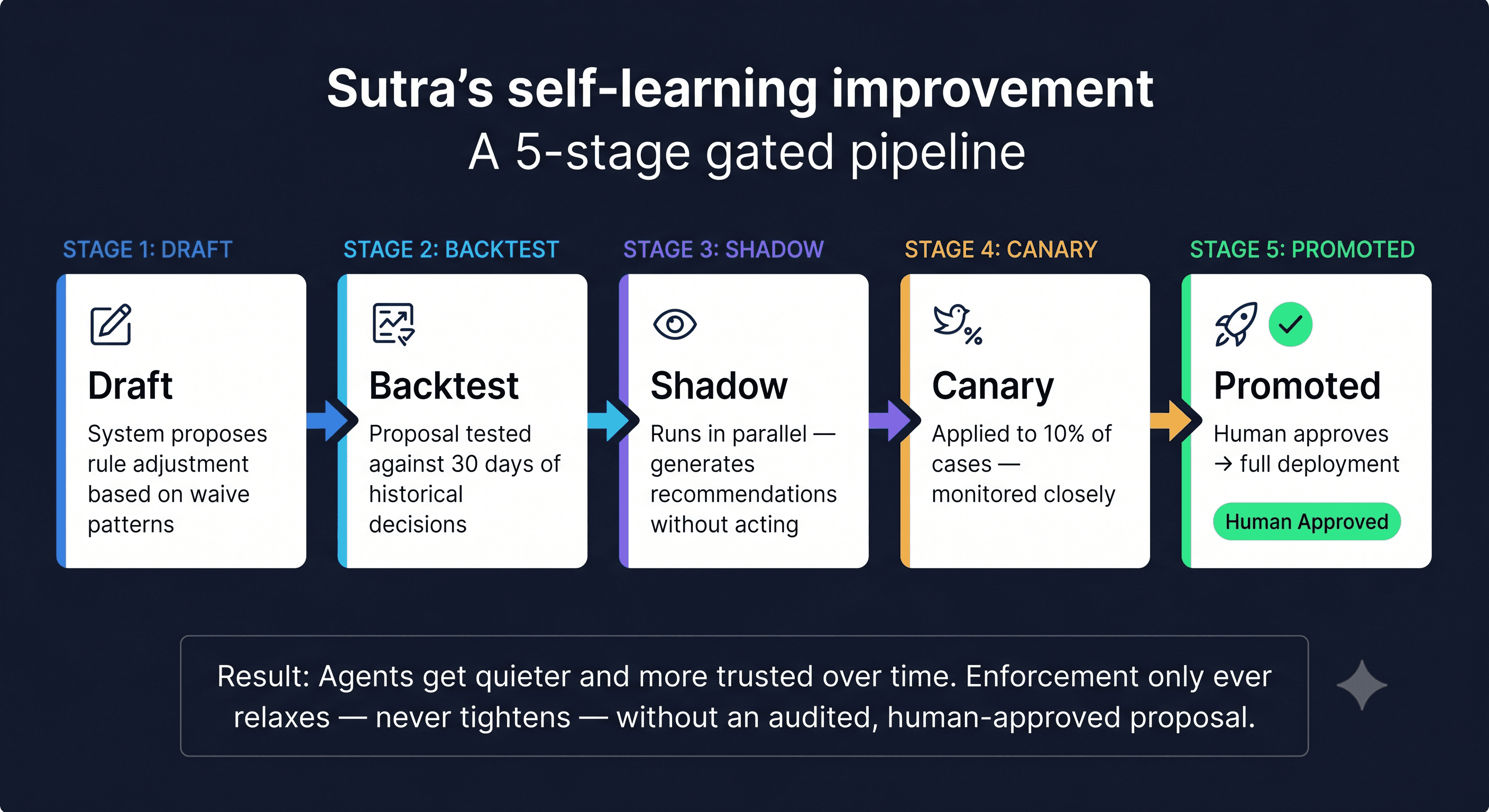
When humans repeatedly waive a rule, Sutra reads it as signal and proposes relaxing it — more grace, then lower severity, then disable. It only ever relaxes under a human-approved backtest, never tightens automatically.
.png&w=3840&q=75)
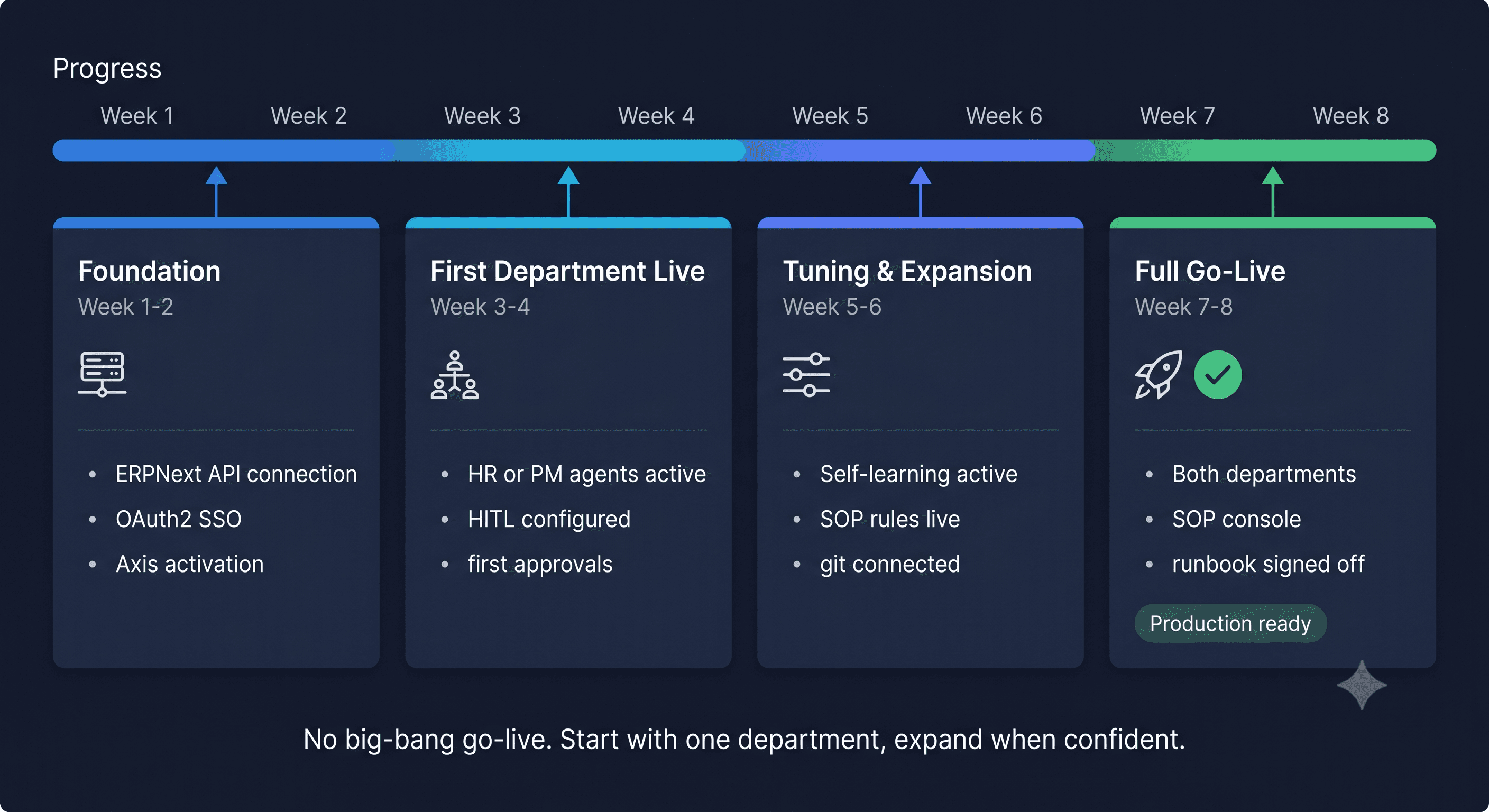
No big-bang go-live. No waiting months for value. Start with your highest-priority department and expand progressively as confidence grows with real data.
ERPNext and Frappe API connection, core services deployment on Azure, OAuth2 SSO configuration, knowledge base ingestion, Axis orchestrator activation and smoke-test validation.
Activate your first agent department — HR or Project Management — configure approval categories and HITL thresholds, then run initial validation cycles with your real live data.
Self-learning engine accumulates feedback signals from approvals and rejections. Tune confidence thresholds, activate SOP rule ladder with grace periods, activate git connectors, expand to second department.
Both departments fully live, SOP compliance console operating, self-improvement pipeline running, full go-live sign-off with documented runbook, pre-flight configuration, and smoke tests.
Sutra links what actually happened in your codebase to what is claimed in your project tracker. Mismatches are flagged automatically. Status finally reflects reality.
Connect via GitHub App or self-hosted GitLab connector behind a unified provider interface. Hundreds of repositories, thousands of commits and merge requests synced in near real time via webhooks with polling fallback.
TASK-#### convention automatically maps commits and merge requests to tasks. Manual override supported. Every task gets its real engineering activity — not just what was typed into the status field.
Task completed but nothing was merged, or code merged but task still open — Tally detects and flags it in real time. Status reflects what actually happened, not what was claimed.
Every approval, rejection, edit, waive, and snooze becomes a feedback signal attributed to the responsible agent. Agents get quieter, more accurate, and more trusted — under a gated five-stage human-promoted pipeline.
.png&w=3840&q=75)
Sutra connects to ERPNext and Frappe as the system of record via standard REST APIs — no custom doctypes, no schema changes. Additional services power the AI, delivery, and self-learning layers.
Sutra interacts with ERPNext and Frappe via standard REST APIs using existing whitelisted methods. Your core ERP remains clean, fully upgradeable, and completely unmodified.
Every write passes through a human approval queue and a single controlled executor with locking and audit. Governance is not a layer bolted on — it is the architecture.
One dedicated install per customer, wired to that customer's own ERPNext in their environment. AES-256-GCM encrypted secrets. HMAC-signed webhooks with replay protection. OAuth2 SSO with role mapping from your ERP.
We review your ERPNext configuration, data quality, and workflows — and identify the highest-impact agent domains to activate first for maximum early value.
Deploy 2 to 3 agents against your live ERPNext data before any full commitment. Measure the real impact with your actual data and your actual team.
Structured phases with clear scope and defined outcomes — no open-ended contracts, no surprise overruns, no big-bang risk.
Adjust the inputs to see how much Sutra could save your organisation each year — in HR admin time, PM overhead, and budget overruns caught before they hit.
Estimated Annual Savings
$185,640
Payback Period
1.7 mo
Year-1 Net Benefit
$158,640
Get your personalised ROI report delivered to your inbox
Book a demo and scope a pilot on your live ERPNext instance — see real named agents, real HITL approvals, and real impact before you commit to anything.