
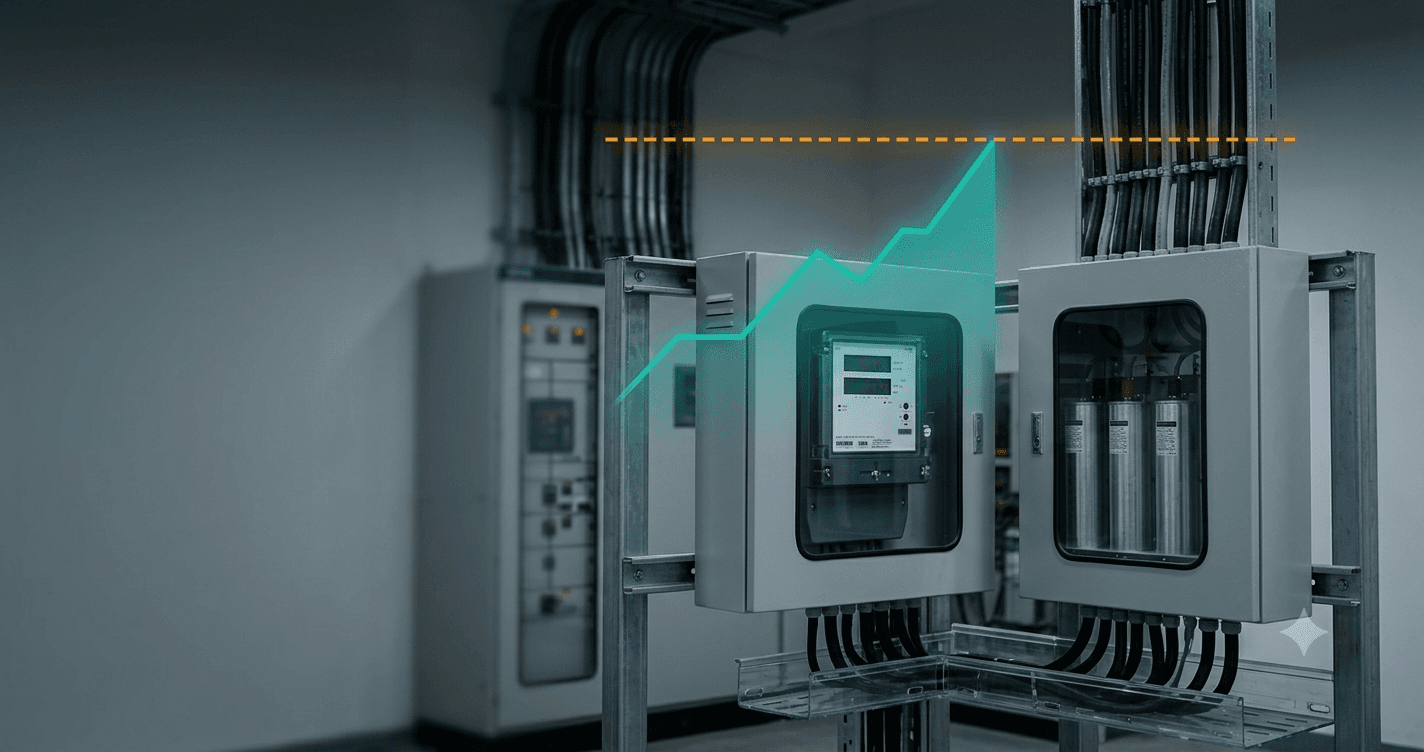
How to Avoid Maximum Demand Penalties and Power Factor Losses in Your Factory
The electricity bill has a maximum-demand penalty again. For 15 minutes on the 12th, two furnaces and the compressor house peaked together. Nobody knew until the bill arrived 30 days later. And the power-factor incentive was lost because an APFC panel stage had stopped switching weeks ago.
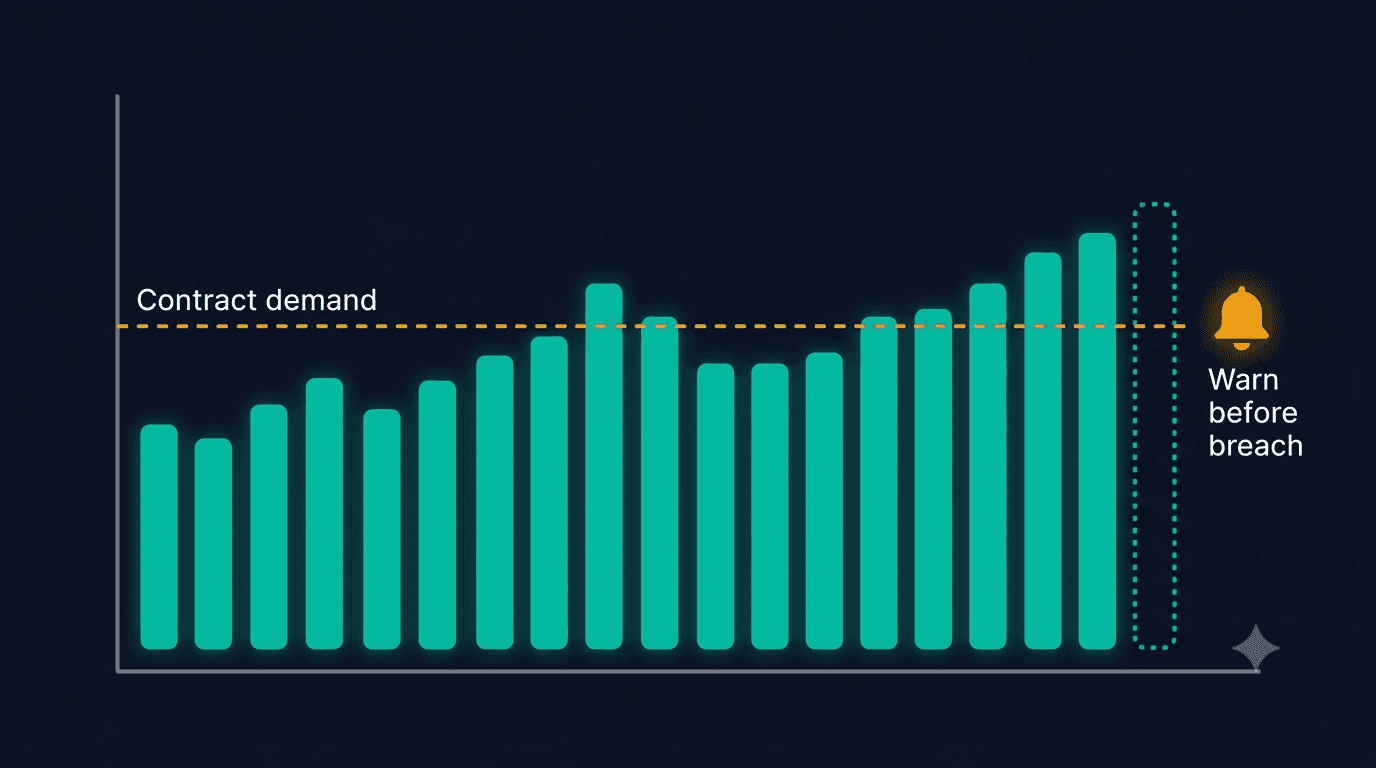
In short: Maximum demand penalties happen because demand is measured in short blocks, but people only see it on the monthly bill. To avoid them, track demand block by block against your contract demand, project the open block, and warn the person on duty before the limit is reached, with a list of loads that can be deferred. Track power factor and APFC stage switching continuously, and price your energy by tariff band.
Why demand penalties and PF losses keep happening
- Demand lives inside the meter. It is recorded in blocks (commonly 15 or 30 minutes), but most plants see it only on the bill.
- Peaks come from coincidence. Furnaces, compressors and large motors starting together in one block create the peak, often at shift change.
- Nobody knows which loads can wait. Without a declared list of deferrable loads, the shift team cannot act even when warned.
- APFC stages fail silently. A capacitor stage that stops switching lowers power factor gradually. The first sign is a lost incentive or a penalty.
- Time-of-day tariffs are ignored. Energy used in peak hours costs more, but nobody sees what moving a load would save.
A practical playbook to control demand and power factor
1. Get a fast demand signal from the main meter
You need kW or kVA at short intervals and the kVAh register from the main incomer. Most modern meters provide this over Modbus.
2. Declare your contract demand and deferrable loads
Write down the contract demand per incomer and which loads can be delayed for a few minutes without harming production, such as a second compressor, a chiller or a non-critical furnace.
3. Project the open block and warn early
Project where the current demand block will end. Warn the person on duty before the limit is reached, while there is still time to shed load.
4. Watch power factor and APFC health
Track the period power factor, the time spent below your target band, and which APFC stages have stopped switching.
5. Price energy by tariff band
Split consumption into time-of-day bands and estimate what moving deferrable loads to cheaper hours would save.

How MIRA warns you before the bill does
MIRA, Techseria's AI plant-intelligence platform, turns the playbook above into live alerts.
- Maximum demand vs contract demand: block and rolling demand, headroom, and a projection for the open block. MIRA warns before contract demand is reached and names the loads your plant declared as deferrable.
- Alerts to the right person: routed by role and site to email, browser push or optional WhatsApp, with escalation if nobody acknowledges.
- Power factor and APFC: instantaneous and period power factor, time below the declared band, and APFC stages that have stopped switching.
- Time-of-day tariff: energy priced per tariff band, plus an estimate of what moving deferrable loads would save.
- Energy roll-up: plant → department → line → machine, with unmetered energy shown as its own line.
- Savings you can defend: maximum-demand and power-factor savings go to a validation queue. They count only when your own engineer approves them.
The penalty is avoided while it can still be avoided, not explained afterwards.
What you need
A fast kW/kVA channel and the kVAh register from the main meter, read over Modbus or another supported protocol. Your contract demand, tariff bands and deferrable loads declared on screen.
Frequently asked questions
What is a maximum demand penalty?
Most industrial tariffs charge a penalty when the highest demand recorded in any block during the month exceeds the contract demand. A single short peak can trigger it for the whole month.
How can I reduce maximum demand without reducing production?
Stagger large loads, especially at shift start, and defer non-critical loads for a few minutes when a block is heading over the limit. This needs an early warning and a pre-agreed list of deferrable loads.
Why is my power factor dropping even with an APFC panel?
A common cause is capacitor stages that have failed or stopped switching. Monitoring stage behaviour shows this weeks before the bill does.
Does MIRA control our loads automatically?
No. MIRA warns and names the deferrable loads. Your team decides what to switch.
How many demand penalties did you pay last year?
And when did you find out each time? See how MIRA monitors demand live or book a demo.
See MIRA on Your Own Plant Data
Bring a month of work orders, a meter export or a PLC tag list. We'll show you what MIRA finds, and what it needs to find more. Unlimited users and assets, installed inside your network.
Ready to accelerate your operations?
See how custom AI solutions, ERPNext integration, and workflow automations can lower your operating costs. Book your free 30-minute Workflow Audit with a senior engineer.