Every facility manager has met the chiller that is always one repair away from working properly. Each call-out is small enough to approve on the spot, so nobody stops to add up what the unit has cost over the years. Then a big failure arrives and the question lands on your desk: do we fix it again, or finally replace it?
Too often that decision is made on instinct, or on whoever remembers the history best. This article lays out a simple, practical way to make it on evidence instead, using the cost and condition records you already generate every day.
Start with the true cost of owning the asset
The purchase price is only the first line of the story. Over its life an asset collects labour for planned visits, labour for breakdowns, spare parts, consumables, outside contractors, energy use and the slow loss of value through depreciation. Most of those costs sit in different places, which is why they rarely get added together.
Total cost of ownership simply means putting them side by side for one asset. Once you can see that a ten-year-old pump has cost more in repairs over the last two years than a new one would cost to buy, the conversation changes from opinion to arithmetic.
Look at how the asset behaves, not just what it costs
Cost alone can mislead. A cheap-to-fix unit that fails every month is still a problem, and an expensive repair on a quiet, reliable machine may be perfectly sensible. So pair cost with behaviour: how often does it break, how long does each repair take, and how much downtime does the site absorb each time?
Two measures help here. Mean time between failures tells you how long the asset runs before it lets you down. Mean time to repair tells you how long it stays down once it does. A falling first number and a rising second number is a strong sign the asset is approaching the end of its useful life.
Give critical assets a different threshold
Not every asset deserves the same patience. A failed pantry fridge is an annoyance. A failed standby generator in a hospital is a risk. Flag your critical equipment so that it is judged by a stricter standard, and so that anyone looking at a repair quote can see straight away what is at stake.
For critical assets, the cost of a single failure usually matters more than the cost of the part. That often argues for replacing earlier than the numbers alone would suggest.
A simple framework for the decision
When a major repair is on the table, ask four questions in order. First, what has this asset cost us over the last year or two, and how does that compare with a replacement? Second, is the failure rate getting worse? Third, how critical is the asset to the site and to contract obligations? Fourth, how much value does it still carry on the books?
If cost is climbing, failures are becoming more frequent, the asset is critical and its book value is low, replacement is usually the sensible answer. If failures are rare, the asset is not critical and the repair is modest, repairing is fine. Write the answer down with the figures beside it, so the decision can be explained later to finance, to clients and to your successor.
How FacilityFlow helps
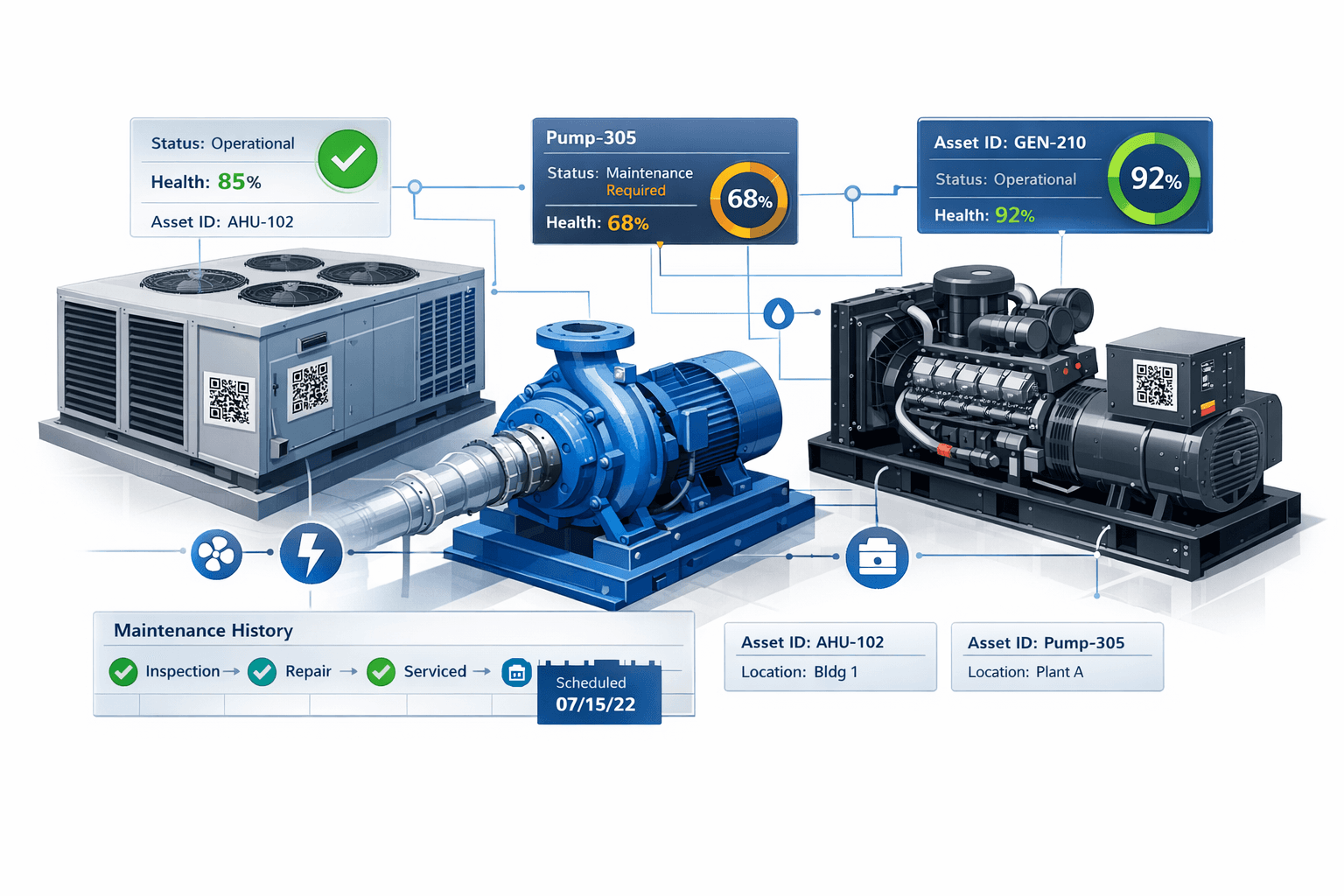
FacilityFlow keeps the whole story of each asset in one place. Every fault, planned visit, part used and downtime event is recorded against the equipment, so service history builds up as a by-product of normal work. Reports such as Asset Total Cost of Ownership, Equipment TCO Analysis, Equipment Lifecycle, Downtime Analysis, Service History and Critical Assets bring it together, alongside MTBF and MTTR figures and an equipment health score that is recalculated every 6 hours.
Because FacilityFlow is built on ERPNext, equipment can create its matching ERPNext Asset, and depreciation syncs back to the equipment record, with a depreciation run each day. Statuses such as Under Maintenance, Out of Service and Decommissioned show where each asset sits in its life, so the finance view and the maintenance view agree.
If you would like to see a repair-versus-replace review built from your own equipment records, book a demo and we will walk you through it.
