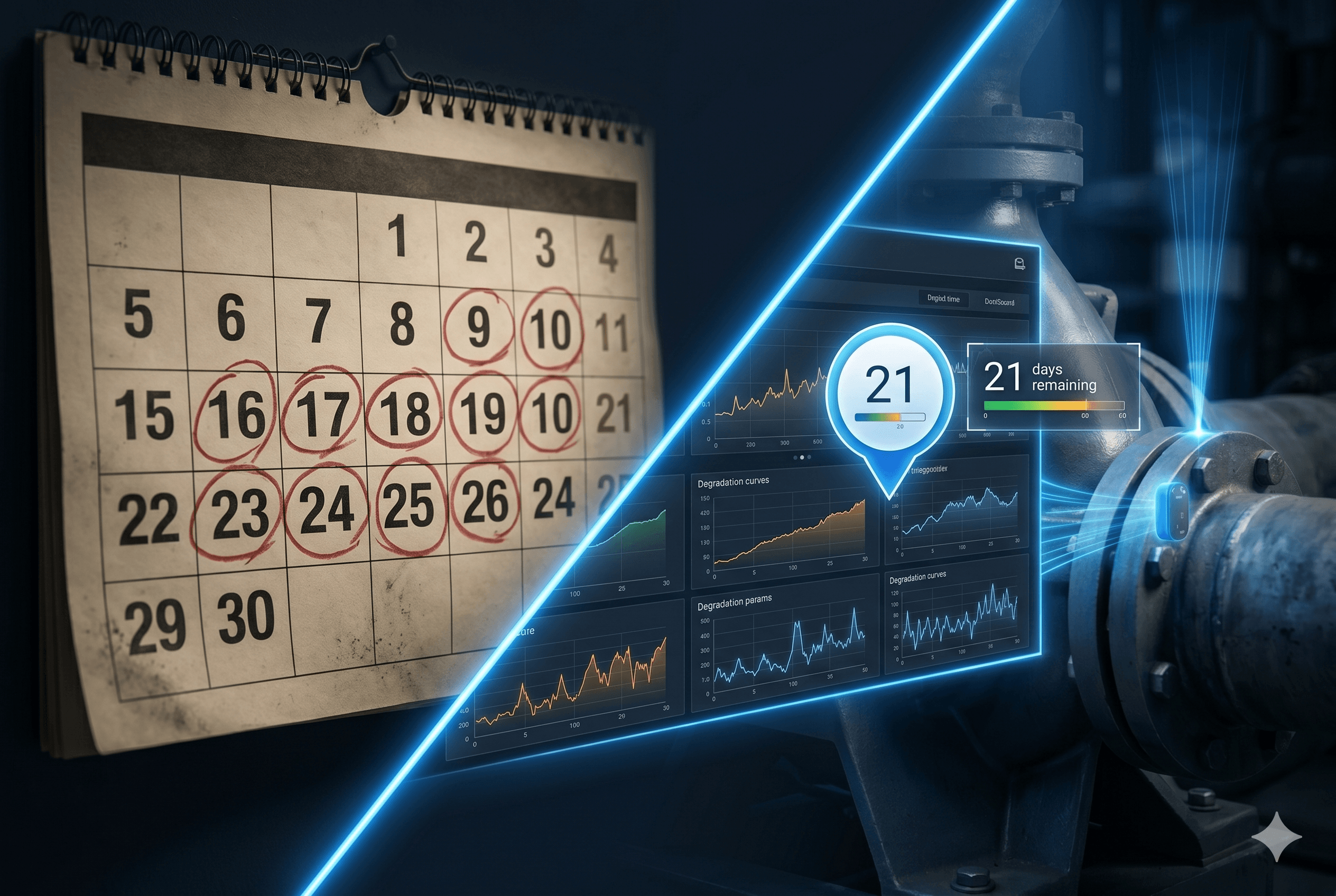
Walk into any plant room and you will find two ways of knowing how equipment is doing. One is a person with a clipboard or a phone, doing a round at a set time. The other is a sensor quietly sending readings all day and night. Most facilities use a bit of both, often without ever deciding that on purpose.
This article compares the two approaches in plain terms: what each one is good at, where each one falls short, and how to choose between them for the assets you look after.
What periodic testing really gives you
Periodic testing means a technician visits, looks, listens, measures and records. It might be a daily walk-round, a weekly generator check or a monthly pump inspection. Its great strength is the human eye. A person notices a smell, a vibration, a puddle, a loose guard or a door that no longer closes properly, none of which a sensor was installed to catch.
It is also cheap to start. You need a checklist, a person and a schedule. The weakness is the gap between visits. If a chiller drifts out of range an hour after the round, you find out at the next one, or when a tenant calls. Rounds also depend on discipline, because a skipped round leaves no data at all.
What continuous monitoring really gives you
Continuous monitoring means equipment and building systems send readings on their own: temperatures, pressures, run hours, energy use, alarm states. You set thresholds, and when a reading crosses one, someone is alerted. Nothing waits for the next round, and you build a long history of how the asset normally behaves.
It is honest to say this takes groundwork. Telemetry needs sensors or a building management system that can share data, and it needs configuration for each site: which points to read, what the limits are and who should hear about a breach. Older plant may need extra instrumentation. Poorly chosen thresholds also create noise, and noisy alerts get ignored.
When to use which
A useful rule of thumb is to ask how costly a surprise would be and how quickly a problem can develop. Critical assets that can fail between visits, such as cold rooms, fire pumps, main chillers or essential power, are good candidates for continuous readings. Slow-moving, low-consequence items are often fine with a periodic check.
Think of the two methods as complementary rather than rival. Telemetry tells you something has changed. A technician tells you why. Many sites use sensors to watch the numbers and rounds to cover everything a sensor cannot, such as condition, cleanliness, safety and general wear.
Making rounds worth the walk
If you rely on rounds, make them consistent. Use a standard checklist for each asset type, capture readings as numbers rather than ticks where you can, and let technicians add photos or a quick voice note when something looks odd. Voice notes matter because a technician with gloves on will say far more than they will type. Offline capture matters too, since plant rooms and basements often have poor signal.
A practical way to decide is to list your ten most critical assets and ask two questions for each. What would a missed problem cost us, and how fast can it develop? The answers usually sort the list into assets that deserve live readings, assets that are well served by a good round, and a few that need both.
Review the split now and then. A threshold that once seemed sensible may be too loose or too tight after a year of data, and an asset that was fine with a weekly check may deserve closer watching after a run of faults.
How FacilityFlow supports both
FacilityFlow handles both sides in one place. For periodic work, the mobile app supports inspection rounds with checklists and voice notes, works offline and syncs without creating duplicates, so a round in a basement still counts. For continuous data, FacilityFlow can ingest IoT and building management telemetry over MQTT or REST, with profiles for BACnet, Modbus, OPC UA, SNMP and KNX, and lets you set thresholds and alerts on the readings.
Both feed the same asset record. Equipment health scores are recalculated every 6 hours from the history held against each asset, and trend anomaly checks and energy spike or drop detection help flag readings that look out of character. All of it is rule-based and configurable, so you decide what counts as a problem. If you would like to see how rounds and telemetry could work together on your own site, we would be glad to give you a demo.
