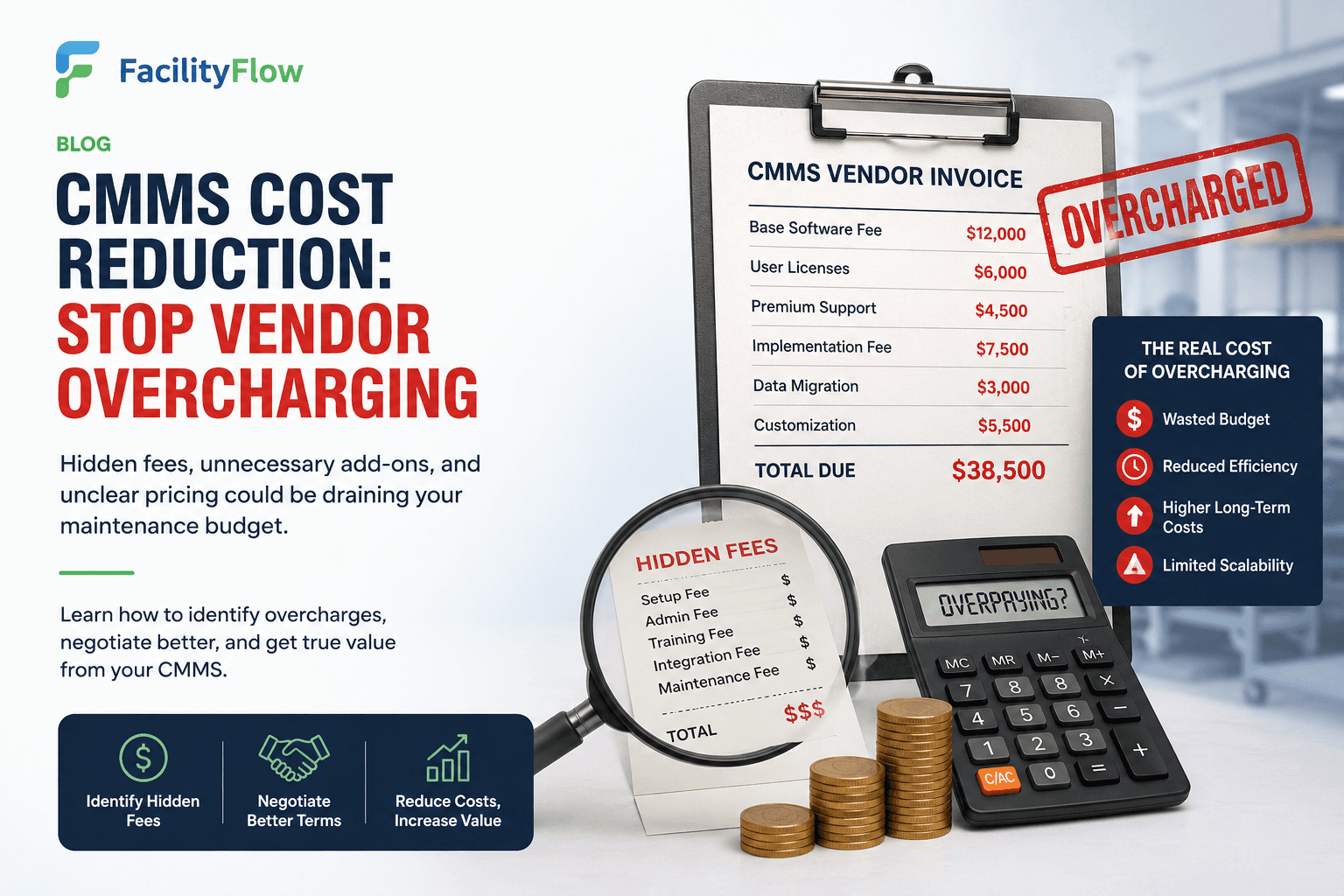
Most facility teams do not lose money in one dramatic moment. They lose it a little at a time: a callout charged at the wrong rate, a repeat visit billed twice, a contract service delivered late with no consequence. Each item looks small on its own invoice, and that is exactly why it slips through.
The fix is rarely a new negotiation. It is having invoices, contracts, service levels and work orders sitting in one place, so the numbers can be compared without a week of spreadsheet work. Here is how that works in practice.
Why overcharging hides in plain sight
When contract terms live in a folder, invoices arrive by email and work orders sit in a separate tool, nobody can easily answer a simple question: did we pay what we agreed, for work that was actually done, on time? Checking takes effort, so it only happens when something looks obviously wrong.
Waste hides the same way. A pump that is repaired three times in a quarter, a vendor who always takes twice as long as the contract allows, a budget line that quietly runs over: all of it is visible in the data, but only if the data is connected.
Capture the cost on every work order
The starting point is simple discipline. Every work order should carry its own costs, whether that is labour, spare parts or an outside vendor's charge. When costs are recorded where the job is recorded, you can see what a given asset, building or contractor really costs to look after.
That also makes repeat work obvious. If the same equipment keeps appearing with new charges, you can ask whether the original fix was done properly and whether the vendor should be covering the return visit. Cost tags for maintenance, energy and cleaning lines link back to the ledger, so the story you see in operations matches what finance sees.
Let contracts and service levels do the checking
A vendor contract is only useful if somebody compares it with reality. With vendor service levels monitored against each job, late responses and missed completion targets are recorded as they happen instead of being remembered, or forgotten, at renewal time.
Vendor performance records are created automatically each day, and each vendor receives a rating built from completion rate, SLA compliance, response time, quality and cost variance. Suppliers are rated too, on delivery, quality, pricing competitiveness and documentation. When it is time to choose who gets the next job, you are working from a track record rather than a hunch. Facility preferred vendors can be set up so the right people get called first.
Price against agreed rates, not memory
If your contract uses a schedule of rates, an FSOR price list gives everyone the same reference for what a standard task should cost. For work that falls outside the list, star rates can be built from supplier quotations, and a star rate register keeps a record of what was agreed and why. A quotation that comes in far above earlier ones becomes easy to spot and easy to challenge.
Budget versus actual, without the guesswork
Budget plans give each site or contract a target, with budget lines and provisional sums tracked alongside. Budget, contract-sum and provisional-sum utilisation reports and spend-versus-budget views show where money is running ahead of plan while there is still time to act, not after the year closes.
Where costs should be passed on to a tenant or a department, chargeback invoices turn recorded costs into bills, and a collection status report shows what has actually been recovered. That closes a gap many teams quietly live with: work done, cost incurred, but never recharged.
How FacilityFlow helps
FacilityFlow keeps work orders, costs, vendor contracts, service levels, ratings, budgets and chargeback in a single platform, with 164 reports to slice the data by site, asset or vendor. Nothing here relies on guesswork: it is plain records, compared consistently, and surfaced to the people who can act on them. Unlimited users and no per-seat fees mean finance, procurement and site teams can all see the same picture. If you would like to see how it would look with your own contracts and invoices, ask us for a demo.
