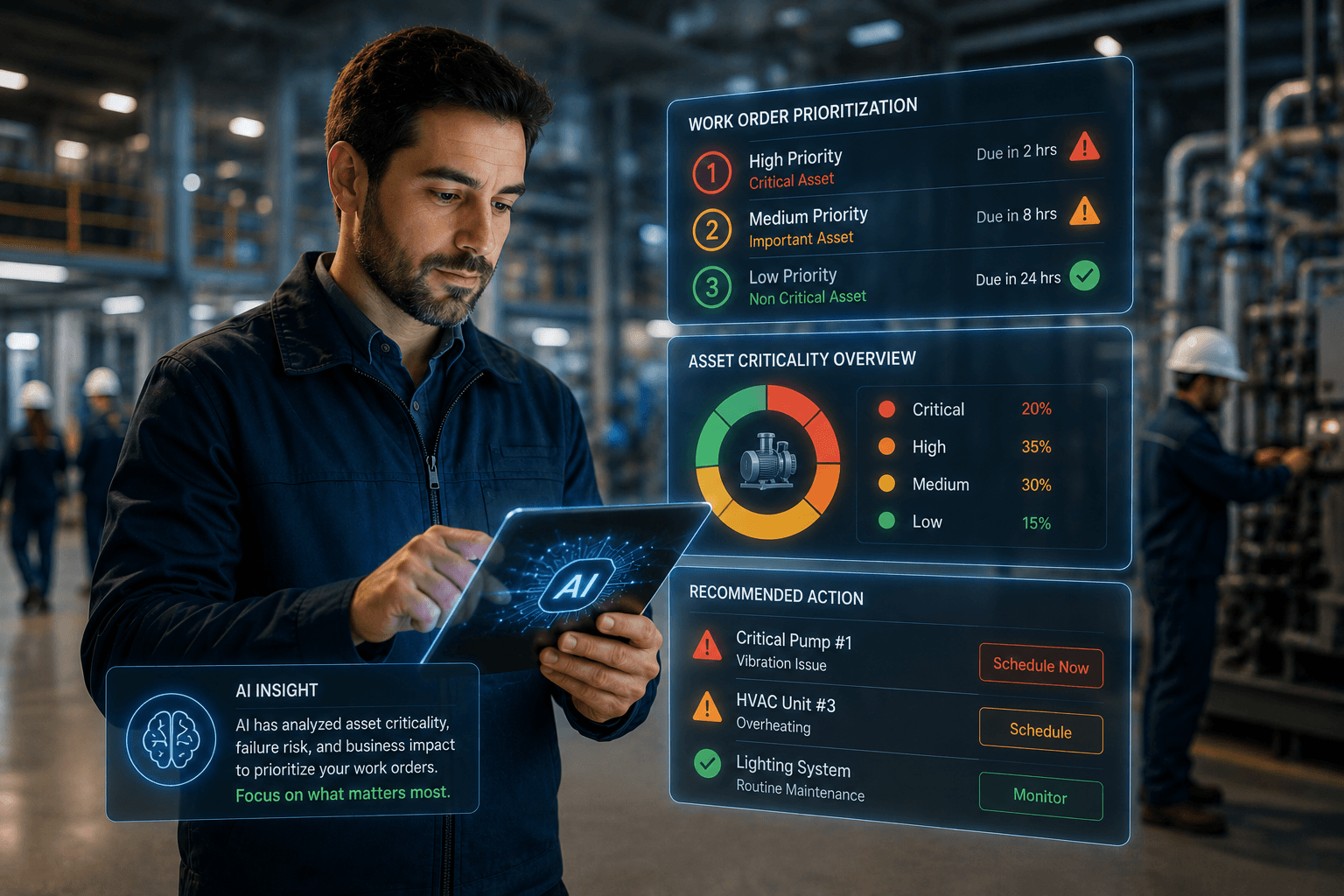
On a busy morning a facility team can face dozens of open requests at once: a leaking tap, a lift that has stopped, a flickering light in a corridor, a server room that feels warm. Everything feels urgent to the person reporting it. Somebody has to decide what gets a technician first, and that decision shapes both safety and your contract performance.
Ranking work well is not about shouting loudest or working first in, first out. It comes down to two questions you can answer consistently: how much does this asset matter, and how much time does the contract give us?
Begin with how much the asset matters
A blocked basin in a rarely used store room and a failed pump feeding a fire system are both faults, but they are not equal. Asset criticality is the simple idea that some equipment carries more consequence when it fails: for safety, for patients or tenants, for revenue, or for compliance.
If criticality is only in people's heads, it gets applied unevenly from shift to shift. Marking critical equipment in the register means the person triaging a request sees the stakes immediately, without needing to know the building by heart.
Respect the clock the contract sets
Many service contracts define two clocks for every fault: a response time, which is how quickly someone must attend, and a recovery time, which is how quickly the problem must be fixed. The clocks often run in working days and depend on the urgency level of the fault.
Two situations need care. Work that is close to breaching should be visible before it breaches, not after. And some delays are legitimate, such as waiting for client access or an approved quotation, so the clock needs a documented pause or an approved extension of time, rather than an argument at month end.
Let urgency be proposed, then confirmed
The person who raises a request is rarely the best judge of its urgency. A sensible pattern is for the contractor to propose an urgency level and for the supervising officer to confirm it. That confirmed level then sets the clocks, so both sides are working from the same agreed number.
It keeps disputes small. If a fault was classed as routine and the client disagrees, the record shows who proposed what and who confirmed it.
A practical habit is to review the at-risk list at the start of every shift. Anything close to its deadline gets a named owner before new work is handed out, which stops the quiet jobs from slipping past their clocks while the loud ones take all the attention.
See the whole queue at a glance
Prioritising is much easier when every request sits in one list. Calls, emails, web forms, mobile reports and QR code scans should land in a single inbox, each showing its clock and whether it is at risk. From there, a board view shows where work is stuck, a map shows where problems cluster, and an ageing heatmap shows which sites are letting requests grow old.
Those views turn a flat list into a picture. If one building keeps turning red, that is a conversation to have with the team, not just a pile of tickets.
Planned work deserves a place in the same ranking. A preventive visit on a critical asset can matter more than a minor corrective job, so it helps when both kinds of work sit in one queue rather than in separate systems that nobody compares.
How FacilityFlow helps
FacilityFlow brings these pieces together. Faults arrive through ten intake channels, including public QR reporting, and appear in a Requests Inbox with their SLA clocks and at-risk filters. The contract SLA engine runs response and recovery clocks in working days, marks work as Pending, At Risk, Met, Breached or Paused, and keeps a full trail of pauses, extension requests and endorsements. Work order SLA escalation is checked every 5 minutes.
Contractors propose urgency and the supervising officer confirms it, and the confirmed level drives the clock. Critical-equipment flags can be set on the asset itself, so importance travels with the equipment. The fault workspace offers a Kanban board, a map and an ageing heatmap.
Once a request becomes a work order, it can be one of nine types, including preventive, corrective, emergency, calibration and fault, and it follows an eleven-stage technician workflow from Open through Assigned, Accepted, Diagnosing and In Progress to Completed, with On Hold when needed. Every step is time-stamped, so the evidence for your SLA performance builds itself.
If you would like to see how your own priorities and contract clocks would look in FacilityFlow, book a demo and we will set it up with you.
