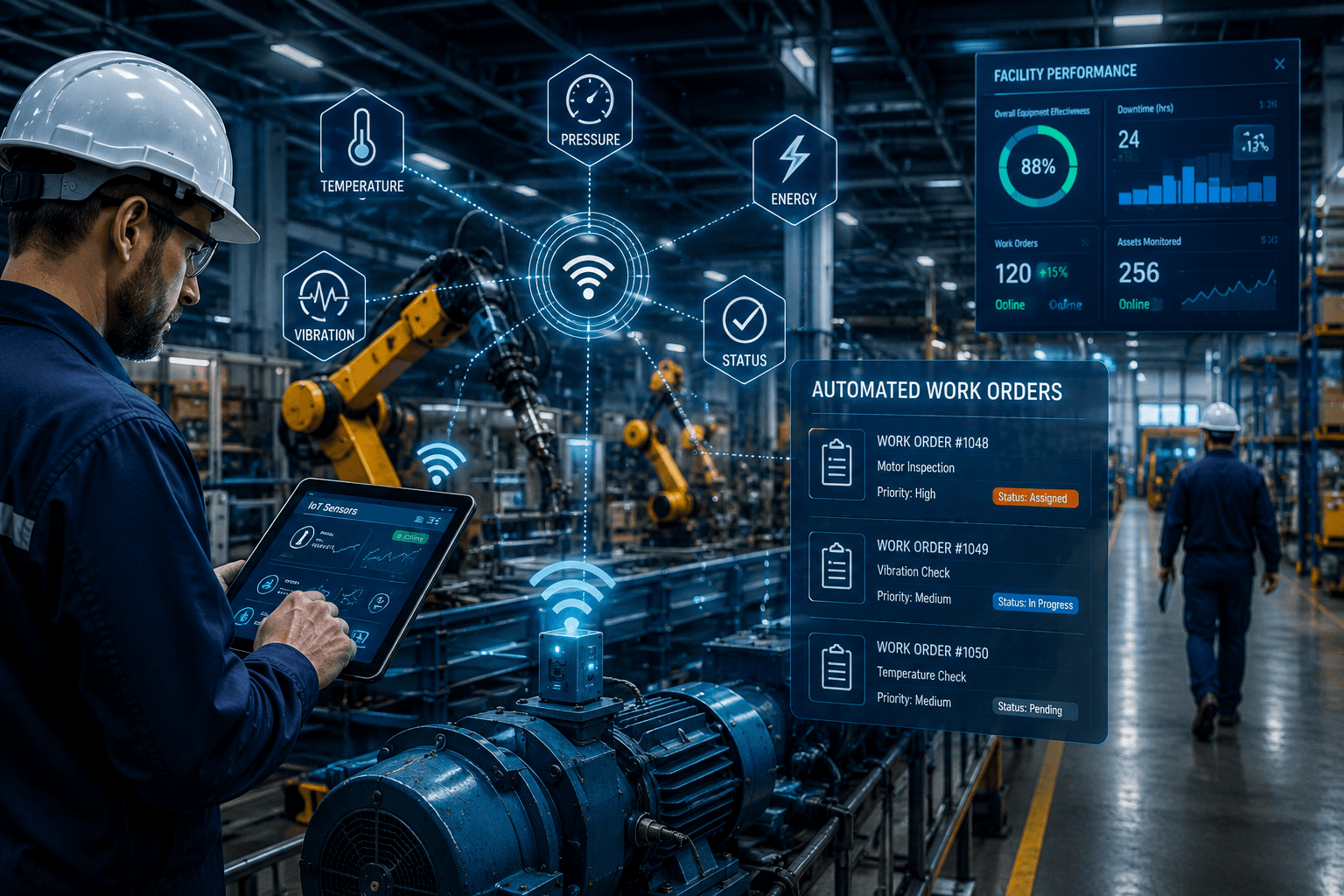
A temperature sensor that nobody looks at is just a cost. The value of sensors in a building comes when a reading that has drifted out of range reaches the right person, in the right place, with enough context to act on it.
This guide explains how that path works in FacilityFlow, step by step, and is honest about what you need to put in place first. Sensors do not connect themselves, and a good plan starts with that.
Step one: getting readings in
FacilityFlow offers several ways in. There is a sensor ingestion REST API for devices or gateways that can post their readings over HTTP, and a native MQTT client for sites that already publish data to an MQTT broker. A configurable webhook is available as well.
IoT devices are recorded with their type, such as gateway, controller, sensor or thermostat, and their connectivity profile, such as MQTT, HTTP/S, Modbus or BACnet. Each reading is stored against a sensor, and each sensor can be linked to the equipment it watches.
Step two: bringing in the building management system
Many buildings already have a BMS collecting data. FacilityFlow holds BMS configuration profiles for BACnet/IP, Modbus TCP, OPC UA, MQTT, SNMP, KNX, LonWorks and HTTP, with authentication options such as basic, API key, OAuth 2.0 or certificate.
Data is imported every hour. Points from the BMS are mapped to equipment in FacilityFlow, and each point shows a status of Online, Offline, Fault or Override. That mapping step is where a technical person should spend time, because a clean point list makes everything after it easier.
Step three: deciding what counts as a problem
A reading is only meaningful against a limit. In FacilityFlow you set threshold rules and conditions per equipment, and each reading is classed as Normal, Warning or Critical. The system also looks for trend anomalies and for energy spikes and drops, which helps catch slow drift as well as sudden jumps.
Start with a small number of sensible thresholds for your most important equipment. It is much easier to add rules later than to untangle a flood of alerts caused by limits set too tight on day one.
Alongside live readings, FacilityFlow keeps equipment health scores and sensor trend views, so a technician looking at an asset sees its recent behaviour and its maintenance history together.
Step four: from alert to action
When a threshold is crossed, an alert is raised and it moves through a lifecycle: Active, Acknowledged, In Progress, Resolved and then Closed or Suppressed. An alert can be linked to a maintenance visit or to a helpdesk issue, so the response is a tracked job with an owner, not a message that gets forgotten. An Alert Monitor page gives the control room a single place to watch.
Sensor data also helps the planned work. Condition-based planned maintenance can be triggered by what the equipment is doing, not only by the calendar, and IoT values can auto-fill readings on maintenance checklists, which saves technicians from typing numbers that the system already has.
A sensible way to begin is with a pilot: pick one plant room or one floor, connect a handful of points, set a few thresholds and watch how the alerts behave for a few weeks. What you learn about naming, ownership and alert volume will make the wider rollout much smoother.
What you still need to provide
It is worth being plain about this. FacilityFlow needs sensors that actually measure the right things, gateways or controllers that can send the data, network access, and some configuration on site to map points and set thresholds. None of that is automatic.
Integrations that are specific to one customer, such as an unusual controller or a proprietary system, are scoped separately. We would rather agree that with you at the start than promise something vague. Sensor data also grows quickly, so FacilityFlow includes a retention policy for it, with daily archiving.
How FacilityFlow helps
FacilityFlow brings IoT and BMS data, equipment records, planned maintenance, work orders and helpdesk into one integrated facility management and CMMS platform. A reading becomes an alert, the alert becomes a tracked job, and the history stays with the equipment. If you are thinking about connecting your sensors, book a demo and we will talk through what your sites would need.
